




Navegación rápida de productos
Solicitar una cotización
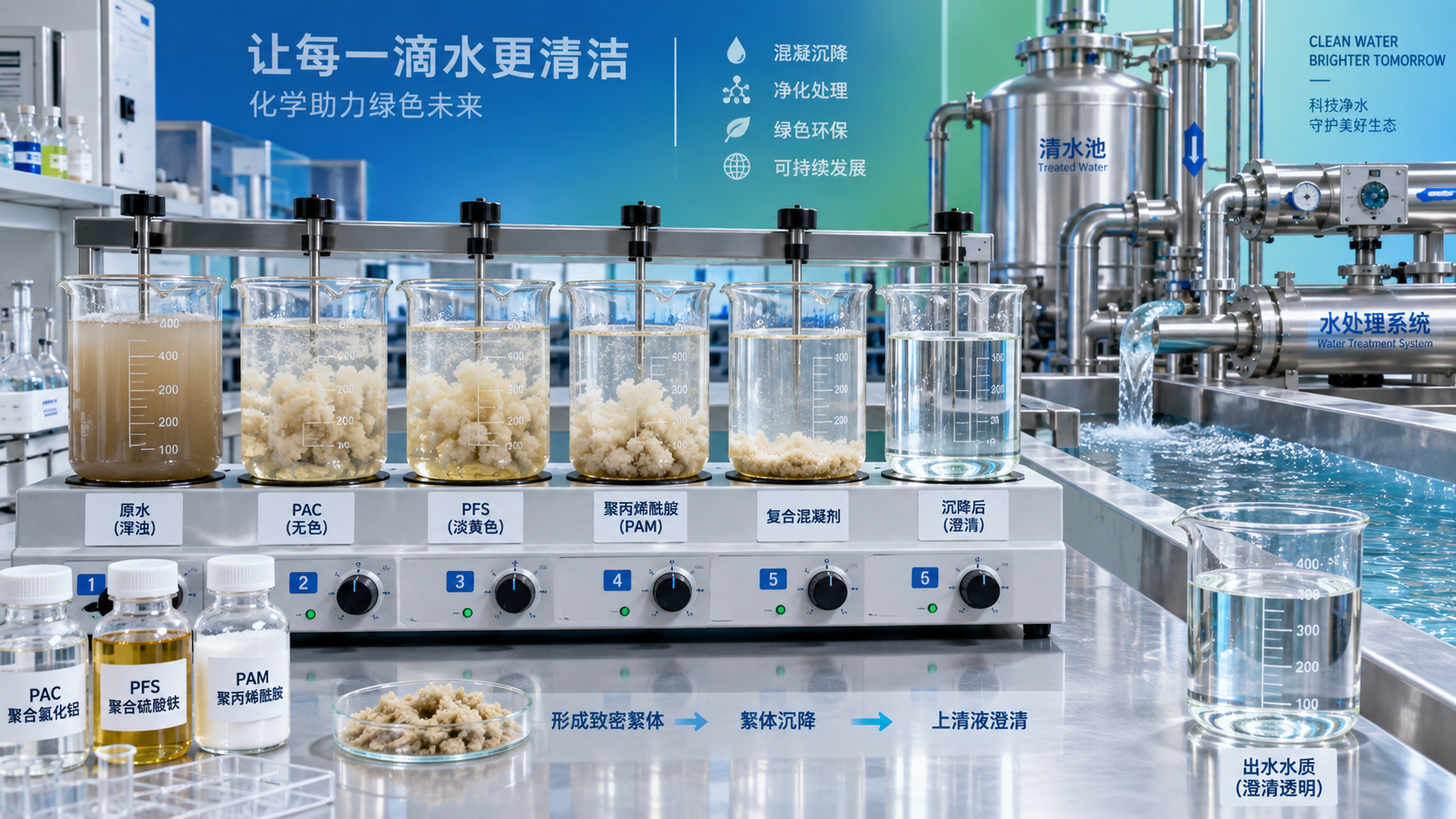
Turbid water should be matched with a coagulant by testing the actual raw water rather than selecting solely by its apparent cloudiness. Suspended clay, organic matter, algae, fine silt, metal hydroxides, and industrial particles can all produce turbidity, yet they respond differently to aluminum salts, iron salts, pre-hydrolyzed coagulants, and organic polymers. A product that clears one source water rapidly may form weak flocs, consume excessive alkalinity, or leave high residual turbidity in another.
Start with the treatment target. Clarification before filtration, drinking-water treatment, wastewater pretreatment, sludge thickening, and process-water recovery do not impose the same limits on pH, residual metal, color, sludge handling, or downstream membrane performance. The selected coagulant must fit the whole treatment train, not merely produce a clear jar-test supernatant.
Identify What Is Creating the Turbidity
Turbidity is a measurement of light scattering, not a direct description of particle type. Two water samples with similar turbidity can require very different treatment. Mineral-rich runoff often contains negatively charged clay and silt particles that remain dispersed because of their small size and surface charge. Surface water may also contain natural organic matter, algae, and fine colloids. Industrial water can include oils, pigments, latex, metal-bearing solids, fibers, or reaction by-products.
This distinction affects coagulant selection because coagulation works through charge neutralization, adsorption, sweep flocculation, or a combination of these mechanisms. A coagulant with strong charge-neutralization behavior may work well on stable colloids but perform poorly when hydrophobic oil droplets or dissolved organic compounds dominate. Conversely, a higher-dose metal salt may create a sweep floc that captures a broad range of fine solids, while generating more sludge.
Useful raw-water observations include:
- Turbidity range and its variability: a stable low-to-moderate turbidity source can be treated differently from storm-affected water that shifts sharply over hours.
- Particle character: settleable grit, colloidal clay, floating algae, and emulsified oil should not be treated as interchangeable solids.
- Color and ultraviolet absorbance: elevated color can point to dissolved organic matter, which often changes coagulant demand and floc behavior.
- Alkalinity and pH: these determine whether a metal coagulant can hydrolyze and form useful precipitates without pushing the water outside its workable pH range.
- Temperature: cold water slows hydrolysis and floc growth, so a dose that succeeds in warm conditions may become unreliable.
A sample with high turbidity from coarse sediment may look severe but settle readily with modest treatment. A lower-turbidity sample containing highly stable colloids may be harder to clarify. Treating the numerical turbidity value as the only selection criterion is a common source of overfeeding and inconsistent performance.
Compare the Main Coagulant Families
Aluminum and iron coagulants are often selected where inorganic suspended solids are the main issue. Their hydrolysis products destabilize particles and provide surfaces that gather fine material into settleable flocs. The chemistry is strongly linked to pH and alkalinity. A low-alkalinity source can lose pH during dosing, reducing coagulation efficiency and creating a need for lime, sodium hydroxide, sodium bicarbonate, or another alkalinity source.
Pre-hydrolyzed aluminum products deserve separate evaluation rather than being treated as direct substitutes for alum. Their degree of hydrolysis, aluminum concentration, and basicity influence their reaction with water. They can be advantageous where rapid floc formation, lower temperature, or restricted alkalinity makes conventional alum less stable. That advantage must still be demonstrated with the relevant source water, because formulation changes can alter optimum dose and settling behavior.
Ferric coagulants are frequently considered when water contains substantial natural color or organic matter alongside turbidity. They can perform well in challenging water matrices, but the practical comparison includes acid demand, corrosion control, sludge characteristics, and the acceptable range for residual iron. A clear settled water sample alone is not enough evidence that ferric treatment is the better option.
Organic coagulants work differently. Their high cationic charge can neutralize negatively charged particles with lower dosage volumes than inorganic salts in suitable streams. They are especially relevant when turbidity arises from certain emulsified or organic particles. However, an excessive polymeric charge can reverse the particle surface charge and disperse solids again. The operating window may therefore be narrower than expected.
pH and Alkalinity Set the Chemical Window
Coagulation is often described as a dose-selection problem, but the workable pH range is equally important. Metal salts hydrolyze after addition, forming positively charged species and eventually metal hydroxide solids. The species present, the floc structure, and the remaining dissolved metal all change as pH changes. Raw-water pH by itself is insufficient; alkalinity shows how much buffering capacity is available to absorb the acidity introduced by the coagulant.
When alkalinity is limited, a coagulant dose may lower pH enough to weaken flocculation. The immediate response is sometimes to raise dose, which can worsen the pH shift and produce extra sludge without improving clarification. Instead, test a pH-adjusted condition beside the unadjusted sample. This separates a true coagulant limitation from a chemistry-control limitation.
High alkalinity is not automatically favorable. It can support metal-salt treatment, but the optimum dose and pH may still differ where carbonate, silica, organics, or metal ions are present. For wastewater, pH changes caused by upstream reactions should be considered at the point where coagulant is actually injected, not only from a composite sample taken elsewhere in the process.
Use Jar Testing to Compare Treatment Routes
A disciplined jar test is the most reliable way to screen coagulants for turbid water. Test representative raw water, including samples from periods of normal and difficult quality where possible. A single grab sample can give a misleading preference if turbidity composition changes during rain, seasonal turnover, batch production, or cleaning operations.
Each test should reproduce the intended sequence: rapid mixing for dispersion, controlled slow mixing for floc growth, and a realistic settling period. Holding the mixing pattern constant is essential when comparing products. A coagulant that looks weak under inadequate rapid mixing may perform well once dispersed correctly; a fragile floc can be destroyed by excessive shear during slow mixing.
Evaluate more than the appearance of the water surface. Record settled-water turbidity, pH after treatment, floc size, floc density, settling rate, sludge volume, and the clarity of water drawn from the intended clarification depth. If filtration follows, pass treated samples through a representative filter medium or conduct a pilot trial. Very fine flocs may create acceptable settled turbidity but rapidly block filters.
The dose-response curve matters. Choose a product that has a usable range around the target dose, not merely the lowest result at one narrow point. Source-water variation, pump calibration, and mixing changes will occur. A coagulant with a slightly higher tested dose but a broader stable range can be easier to control than one that fails when dosage shifts modestly.
Where an inorganic coagulant alone leaves small, slow-settling flocs, a low dose of flocculant may improve aggregation. This is a separate decision from primary coagulation. The flocculant should be screened after establishing the most suitable coagulant and pH condition. Adding polymer before understanding the primary chemistry can mask the reason for poor results and create unnecessary chemical use.
Do Not Compare Products by Delivered Volume Alone
Liquid coagulants differ in concentration, density, active metal content, acidity, and basicity. Comparing two products only by liters dosed can make a concentrated product look expensive or a dilute product look efficient. Compare treatment performance against active chemical basis where relevant, while also calculating delivered dose, storage demand, freight constraints, and required dilution water.
Sludge is part of the comparison. Metal-based coagulants add inorganic solids and often increase sludge mass or volume, particularly when sweep flocculation is used. That may be acceptable when clarification is robust and dewatering capacity is available. It becomes a controlling issue where sludge storage, thickening, filter press capacity, or disposal restrictions are tight. A lower chemical purchase cost can be offset by additional sludge handling.
Feed-system compatibility also changes the practical choice. Ferric chloride is strongly corrosive and demands appropriate tanks, piping, valves, secondary containment, and dosing equipment. Aluminum products and organic coagulants have their own storage and temperature constraints. Settling or crystallization in stored material, incompatibility with dilution water, and inaccurate metering can create apparent treatment failures that are actually handling problems.
Watch for Misleading Treatment Results
Fast clarification does not always mean stable treatment. A dense floc that settles quickly may still release fine particles when hydraulic conditions change in a clarifier. Conversely, a visually bulky floc can be light, fragile, and difficult to dewater. Observe floc strength during gentle agitation and assess whether the settled solids compact over time.
Residual turbidity after coagulation also has several possible causes. It may reflect insufficient coagulant dose, but it can also result from incorrect pH, inadequate rapid mixing, excessive shear, short flocculation time, hydraulic short-circuiting, dissolved organics, or a poor coagulant-flocculant sequence. Raising the dose without isolating these causes may increase residual metal and sludge while leaving the real problem unresolved.
Temperature deserves particular attention when cold raw water is expected. Hydrolysis reactions and particle collisions slow down, while flocs may become smaller and settle less readily. Compare candidates at the coldest practical sample condition or retain a treatment margin based on seasonal testing. A product selected only under warm-water conditions can become unreliable when performance is most needed.
Match the Selection to the Downstream Process
For sedimentation followed by conventional filtration, seek a floc that settles well and does not overload the filters. For dissolved air flotation, lighter flocs that attach effectively to bubbles may be preferable, especially with algae, oil, or low-density solids. Membrane pretreatment requires attention to residual coagulant, fine floc carryover, and fouling behavior. Biological wastewater treatment may require confirmation that the added chemical and pH adjustment do not disrupt the downstream biological stage.
Where treated water has a residual-metal limit or a sensitive reuse application, measure the residual parameter rather than inferring it from low turbidity. Clear water can still contain dissolved aluminum or iron when pH and coagulant conditions are unfavorable. For potable, discharge, reuse, or process-water applications, local requirements and the receiving process should define the final acceptance criteria.
Select the coagulant after comparing representative samples under controlled mixing, pH, and settling conditions. The strongest option is the one that maintains acceptable clarified-water quality through realistic raw-water variation while fitting the available feed equipment, alkalinity control, sludge capacity, and downstream treatment process.
Envíenos hoy su consulta